
22/12/2025
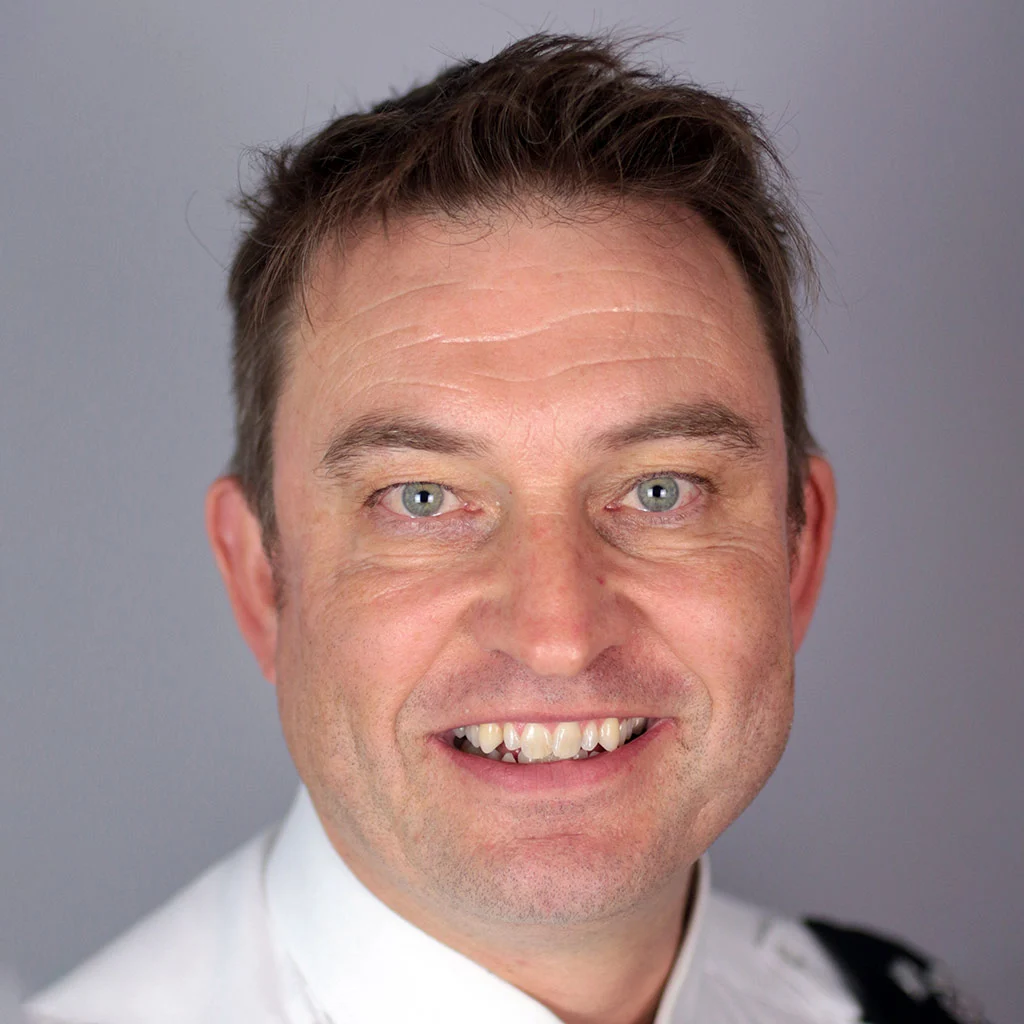
Clive Hammond
Here, Cambridgeshire Constabulary's Chief Constable, Simon Megicks, discusses with Police Oracle how policing has helped shape his life, the experience of rising to the region's top policing post and what the future looks like.
November 1, 2025.
CC Megicks is at home ironing, and beginning to contemplate what the rest of his night might have in store.
Then he gets the call from a commander.
Moments earlier, an attacker made their way through an LNER train shortly after it left Peterborough station, destined for London King’s Cross on its service from Doncaster.
Accounts from inside the carriages illustrate how the attacker stabbed at least 10 passengers, sparking desperate calls to the emergency services and the train’s alarms being accessed.
As a result, the train was diverted to Huntingdon, where armed officers were on hand to grab the suspect – Anthony Williams, 32, who has been subsequently charged with 10 counts of attempted murder.
“It was a Saturday evening and in my house I happened to be chief ironer, of all things,” CC Megicks shares as he sits down with Police Oracle.
“I was setting up to do the ironing, and I got the call from the commander to say: ‘We’ve just been called to an incident here in relation to the train coming in. Looks like I’ve got lots of people that have been stabbed on the train.’
“And from [that moment] of collecting the shirts that need ironing… you need to switch, and I switched right away…”
When he reached the command centre, CC Megicks saw with his own eyes “some fabulous things” from staff and officers who were helping secure one of the region’s most shocking incidents.
He continued: “I can’t praise the call handlers enough, who saw and understood what was going on very, very quickly, who sent the messages through to the commanders, to our inspector in the control room… who made all the right calls into the wider command structure.”
CC Megicks recalled that in recent weeks, he had received a letter from a local senior clinician, who said that as a consequence of the force’s officers who “flipped from dealing with a high threat to first aid medical support”, that as opposed to injuries, medical professionals would have been dealing with fatalities that night.
He continued: “[There is] no doubt in the minds of those that were down at the scene that if it wasn’t for the police, lives would have been lost. Not as a consequence, necessarily of the individual that we’ve now dealt with, but without swift and professional first aid and medical care that our officers gave… people would have died.
“I don’t want to switch off from that.”
Police Oracle is speaking to CC Megicks from inside Cambridgeshire Constabulary’s Huntingdon base, less than a five minute walk from that train station, to talk about his new role as chief constable.
For around 30 years, CC Megicks has worked within policing in a variety of posts, including time away from Cambridgshire – where he grew up – as Assistant Chief Constable in Hertfordshire and Deputy Chief Constable in Norfolk and Suffolk.
It’s led to a life full of pivotal experiences, including “really tough times,” the chief constable reflected.
“I used to be involved in child death… and having to go to a post mortem of a very young child, while having a daughter of the same age or there abouts – that’s tough,” he said.
“I still think about that, or being exposed to indecent images of children…I remember going down to Addenbrooke’s Hospital (in Cambridge) and having to pull off the road to have a moment to myself. In fact, I rang a colleague and said you might need to just put a bit of steel in my back here because I’m in a bit of a wobbly place.”
But there are an abundance of positives for CC Megicks, where he and colleagues have made a real difference, whether this be facing down violent men, or in developing strategies that have helped bring criminals to justice and closure for victims.
He reflected: “We are on the side of good… I’ve got a son and he would ask me when he was very little, did I work for Batman?
“Now, putting aside the kind of issues of being a vigilante, I said: Yes we are… we do stop bad people doing bad things. And I hold that really dearly.”
CC Megicks replaced Nick Dean, who stepped down after seven years leading the force, back in September.
He’s previously cited how the biggest priorities for him are the need to install a new leadership team, as well as reassessing the processes within Cambridgeshire Constabulary to ensure there is a fair distribution of work across the organisation while making sure that those who are doing the most for the public get the most support.
Another key aspect is continuing to support those who are struggling with their mental health on the frontline.
In an age where an officer can become an online pin-up for abuse and their performance criticised widely across many platforms, the desire to place mental health at the centre of an officers’ role has never been stronger.
“It’s about identification of, supporting and recognising that some people just need a moment to decompress,” CC Megicks continued.
“Or it’s also reminding people that actually, you might need a little bit more time or you might just want to talk it through with the team.”
On his own leadership, he added: “I think we need to empower leaders… I had quite robust, honest and candid sergeants and inspectors and if you need to be told off, they tell you off, but they weren’t telling you off to be harmful or but to get you back on track.
“And there were two times where my fire quality probably wasn’t quite good enough, or when I’ve done something that has offended a member of the public… you absolutely knew about it.
“I’m not necessarily advocating a kind of brutal but I do think that we do need, collectively and through the service, to be candid and honest and help people ensure that they don’t get to that point where it becomes fairly catastrophic for their careers.”
Starting out in 1996, the offices of Cambridgeshire Constabulary are a world away from what is seen now – not least through the “radically improved” professionalism.
This, CC Megicks said, has been conducted in a variety of ways, such as how the force trains, the rigour it applies, and the standards and ethical approaches it implements.
“Now I’m not saying we were unethical at the time,” he continued.
“But the focus on making sure we do everything right, the accountability is significantly higher, and an example being, when I was a young police officer, nobody had a mobile telephone. Nobody had a really high quality camera in their pocket.
“Now, so much of what policing does is on somebody’s camera somewhere. Certainly in my time, we were professional. What we did, we did, and we did things right, but you didn’t have cameras shoved into your face, and you weren’t being scrutinised for every particular second.
“I think officers and staff now have in delivering policing today, have that kind of accountability really up close in ways that I don’t think we did.”
There was also greater expectations from the public, due to the “unfortunate journey” that policing has gone through over the past years, not least the Charing Cross Panorama expose and Wayne Couzens.
He noted that a “small number” of police officers had “done some fairly awful things”, and that has a “real impact” on the services throughout the UK.
CC Megicks said it was right that the public expectation of forces continued to grow but often “we expect a lot of young people who do quite extraordinary things most of the time”.
So why policing? And how does he look back on his career now, 29 years on?
Well, it may never have been the force to start with, as the chief constable originally completed a degree in physics before joining the Army.
However, he was drawn to the force to help support the community, and ended up having “the most marvelous…. most varied career on almost every metric”.
The challenges he has faced, intellectually, physically and politically, have continued his love affair with policing which shows no signs of slowing down.
He concluded: “Ultimately, when you look at your ledger of life, on the good side you will [be] overflowing with good things that you’ve had the opportunity to be part of, or to do and make a difference in for other people.
“So what more can I say really? I’m blessed.”